

The Statue of Liberty is a global icon: a crowned figure, torch in hand, tablet in the other, standing in New York Harbor. It symbolizes freedom and hope. Yet, this familiar image omits a crucial detail: the original monument featured a broken shackle and chain at her feet. This element, central to the statue’s radical abolitionist message, was later minimized. To truly understand Lady Liberty, we must confront why she was depicted with these shackles—and how this symbolism was hidden in plain sight for over a century.
The journey of this symbol, from central statement to obscured detail, is a tale of art, politics, and shifting national memory. It forces us to re-examine what we know about a world-famous monument. This article covers the history, meaning, and controversy of the original Statue of Liberty with chains. We’ll explore why this design was chosen, why it was minimized, and why recovering this truth is crucial to understanding the statue’s message.
The Radical Vision of Édouard de Laboulaye and Frédéric Auguste Bartholdi
To grasp why the Statue of Liberty was originally conceived with chains, we must start not in America, but in France, with two men: Édouard de Laboulaye and Frédéric Auguste Bartholdi. Laboulaye was a French legal scholar, a staunch supporter of the American republic, and a fierce abolitionist. He admired the U.S. Constitution but was deeply critical of the nation’s original sin: slavery. For Laboulaye, the true celebration of American liberty was not the revolution against Britain, but the emancipation of enslaved people following the Civil War. He saw the Union’s victory as the final, triumphant realization of the promise of 1776.
Laboulaye’s idea for a monument was born from this sentiment. He proposed a gift from France to the United States to commemorate the centennial of the Declaration of Independence and, more importantly, to honor the preservation of the Union and the end of the institution of slavery. This was not to be a generic statue of freedom; it was to be a specific commentary on liberation from bondage. He enlisted the talented sculptor Frédéric Auguste Bartholdi, who shared his anti-slavery convictions, to bring this vision to life. Bartholdi’s early models and drawings leave no doubt. They consistently show a powerful, striding female figure, often in the act of moving forward. In her left hand, she holds a tablet inscribed “JULY IV MDCCLXXVI.” In her raised right hand, she holds a torch. And at her feet, clearly visible, lies a broken chain.
This iconography was deliberate and rich with meaning. The figure is not static; she is in motion, having broken free. The shackle and chain are not intact; they are shattered, symbolizing a rupture with the past of enslavement. Bartholdi and Laboulaye were creating an allegory for Liberty emerging from tyranny and oppression, with the broken shackles serving as the most visceral evidence of that tyranny overcome. The statue’s full title, “Liberty Enlightening the World,” thus had a double meaning: she was both a beacon for immigrants and a symbol of the light of emancipation dispelling the darkness of slavery. The original Statue of Liberty with chains was, at its heart, an abolitionist monument, a celebration of the end of chattel slavery in the United States.
The Symbolism of the Broken Shackle and Chain
The broken chain at Statue of Liberty’s feet was not a subtle accessory; it was a foundational piece of her story. In classical and neoclassical art, broken chains are a well-established symbol of achieved freedom, of tyranny overthrown. Bartholdi, working in this tradition, placed this symbol in a specifically American context. The chain links were meant to be large, unmistakable, and fragmented. In some designs, the chain was shown trailing behind her left foot, which was often lifted as if she had just stepped forward out of its grasp. This dynamic pose reinforced the narrative of active liberation.
Furthermore, the shackle itself holds deep significance. It is specifically a broken shackle, not a manacle or a simple rope. A shackle is an instrument for binding the ankles or wrists, a direct reference to the physical restraints of slavery. By showing it broken, Bartholdi visualized the shattering of the institution itself. This symbolism was intended to be read in conjunction with the statue’s other elements: the torch (enlightenment, progress), the tablet (the rule of law, specifically the law that abolished slavery), and the crown’s seven rays (representing the seven continents and seas, implying that liberty is spreading worldwide). The shackles were the “before” in the statue’s story of “before and after.” They grounded the lofty ideal of liberty in a specific, hard-won historical struggle.
This symbolism would have been immediately legible to a 19th-century audience, particularly in the aftermath of the Civil War and the recent horrors of the Haitian Revolution, which was very much in the consciousness of French abolitionists like Laboulaye. The original Statue of Liberty with chains was designed to be an unambiguous monument to emancipation. It declared that American liberty was not an abstract philosophical concept, but a concrete victory over the brutal reality of enslavement. The chains were evidence of the struggle, making the statue’s triumphant pose all the more powerful and meaningful.
The Disappearing Act: How the Chains Were Minimized
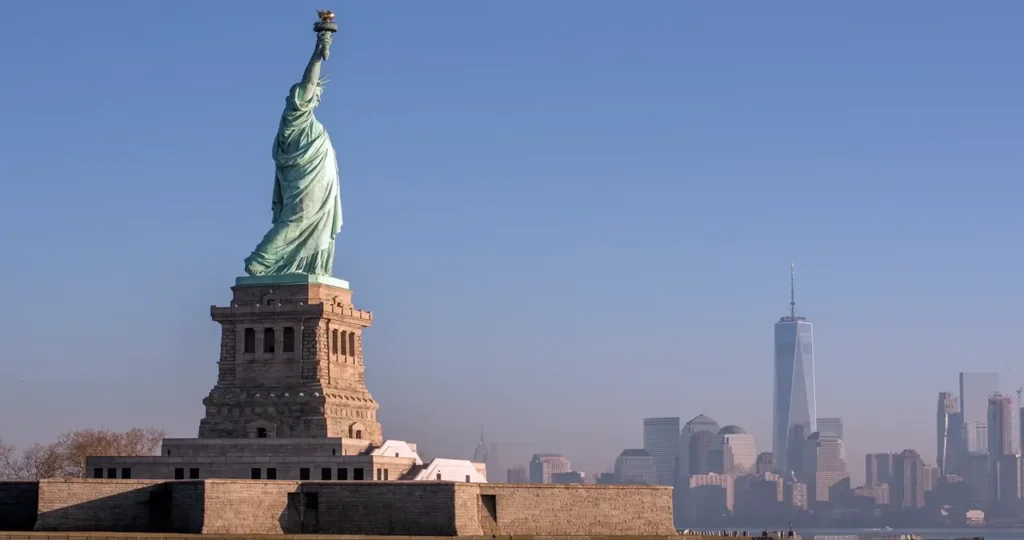
Despite the clear intent of its creators, the powerful symbol of the shackles on the original Statue of Liberty underwent a process of minimization that began even before the statue was completed. The most significant change was one of perspective. In Bartholdi’s final construction on Liberty Island, the broken chain and shackle are placed at the statue’s right foot, largely obscured from view by the drapery of her robes and the massive pedestal. From the standard ground-level vantage point, they are virtually invisible. You cannot see them unless you are looking down from above—either from a helicopter, an aerial photo, or from inside the statue itself, looking out a window in the pedestal.
This architectural choice has led to a century of obscurity. Postcards, photographs, and films almost never show the chains. The dominant image became the clean, unencumbered figure, torch held high. Why did this happen? Historians point to several factors. First, there were practical and aesthetic concerns from American sponsors and engineers. Some found the chains visually cluttered or feared they might be misunderstood. Second, and more critically, the political climate in the United States shifted rapidly in the decades following the statue’s 1886 dedication. The hopeful period of Reconstruction, which sought to establish racial equality, was brutally dismantled by the rise of Jim Crow laws, segregation, and white supremacist terrorism.
As the nation actively retreated from the promise of emancipation, a monument that explicitly celebrated the end of slavery became inconvenient, even controversial. It was easier to recast the Statue of Liberty as a symbol of general freedom and, later, specifically as a welcome to European immigrants arriving at nearby Ellis Island (which opened in 1892). This narrative, while powerful in its own right, deliberately softened the statue’s radical, abolitionist edge. The shackles, the physical proof of that radical history, were literally pushed out of sight. The process wasn’t a single act of censorship, but a gradual cultural amnesia, facilitated by the statue’s own design and a nation’s unwillingness to confront the central role of slavery and its aftermath in its story.
Rediscovering the Truth: Modern Scholarship and Public Awareness
For most of the 20th century, the story of the original Statue of Liberty with chains remained a niche historical footnote. The dominant narrative of the statue as a beacon for immigrants was so entrenched that the abolitionist origin seemed almost heretical. However, beginning in the late 20th and accelerating in the 21st century, historians, curators, and public intellectuals began to piece the evidence back together. Scholarly works, museum exhibits, and increased public access to Bartholdi’s original models forced a re-examination.
Key to this rediscovery was the work of researchers like Rebecca M. Joseph, Ed Berenson, and others who delved into the archives of Laboulaye and Bartholdi. They published findings that clearly linked the statue’s conception to the abolitionist movement and the celebration of the Union’s victory. The National Park Service, which administers the Statue of Liberty National Monument, gradually updated its official materials to reflect this history. Today, the park’s museum on Liberty Island explicitly addresses the broken chain and its meaning, stating that the statue was “conceived in the aftermath of the American Civil War and the abolition of slavery” and that the chain “symbolizes the breaking of the shackles of slavery.”
This shift represents a significant change in public history. It acknowledges that symbols evolve, but that their original intent matters. The rediscovery of the shackles has transformed the statue from a static icon into a dynamic historical document, one that speaks to the ongoing struggle for liberty and justice. It has also sparked important conversations about which stories we choose to memorialize and which we choose to forget. By bringing the chains back into the light, we are not just correcting a historical fact; we are reclaiming a more honest, complex, and powerful understanding of what the Statue of Liberty was meant to represent.
The Chains in Contemporary Culture and Debate
The renewed awareness of the original Statue of Liberty with chains has inevitably spilled over into contemporary cultural and political debates. The statue, as a supreme national symbol, is often invoked in discussions about immigration, civil rights, and national identity. Understanding her abolitionist roots adds a potent layer to these conversations. For activists and scholars advocating for racial justice, the restored narrative provides a powerful historical anchor. It frames Liberty not just as a passive welcomer, but as an active participant in a liberation struggle, her broken shackles a reminder of a fight that is, in many ways, unfinished.
This has led to calls for a more prominent display or acknowledgment of the chains. Some suggest that the Statue of Liberty’s presentation—through replicas, educational materials, and media—should consistently include the chain imagery to reflect its true design. Others see the obscured chains as a metaphor for America’s own obscured history of racial injustice, a hidden truth that must be consciously sought out and acknowledged. The debate touches on broader questions: Should national monuments be re-contextualized as our understanding of history deepens? How do we honor the complicated, often painful truths behind our most cherished symbols?
Furthermore, artists and filmmakers have begun to incorporate this knowledge into new works, using the image of a shackled Statue of Liberty to comment on modern issues of mass incarceration, systemic racism, or the treatment of refugees. The symbol has been liberated from its physical hiding place and entered the cultural lexicon as a tool for critique and reflection. This ensures that the original intent of Laboulaye and Bartholdi—to create a monument that speaks forcefully to the cause of human freedom—continues to resonate, perhaps even more powerfully today than it did in the politically ambiguous Gilded Age in which the statue was unveiled.
A Comparative Look: The Original Vision vs. The Prevailing Narrative
To fully appreciate the transformation of the statue’s meaning, it is helpful to compare the original, abolitionist vision with the prevailing 20th-century narrative. This isn’t about which is “correct,” but about understanding how emphasis and context can reshape a symbol.
| Primary Meaning | Celebration of the end of slavery (Emancipation). | Welcome to immigrants arriving at Ellis Island. |
| Central Symbol | The broken shackles and chain at Liberty’s feet. | The raised torch and the “Mother of Exiles” sonnet. |
| Historical Context | Post-U.S. Civil War, French anti-slavery movement. | Age of mass European immigration, Cold War symbol of freedom. |
| Key Figures | Édouard de Laboulaye (abolitionist), Frédéric Bartholdi. | Emma Lazarus (poet), early 20th-century immigrants. |
| Liberty’s Action | Breaking free from bondage; a dynamic act of liberation. | Holding a light for others; a static, benevolent presence. |
| Visibility of Chains | Central, intended to be a key visual element. | Obscured, largely unknown to the public. |
| Implied Audience | America, confronting its past of slavery. | Newcomers, looking toward a future in America. |
This comparison shows a profound shift from a monument about internal liberation from a specific evil to one about external welcome. Both are valid aspects of the American experience, but for decades, one completely overshadowed the other, fundamentally altering the Statue of Liberty’s perceived message.
Voices on the Symbol: Quotes Statue of Liberty and Her Chains
The story of the Statue of Liberty chains has inspired commentary from historians, writers, and thinkers. Their words help capture the significance of this rediscovered history.
“The Statue of Liberty was born out of a desire to honor the end of slavery. That’s the forgotten history. The shackle is there for a reason.” – Edward Berenson, historian and author of The Statue of Liberty: A Transatlantic Story.
“We have to remember that the original statue is striding forward. She is moving. And she has broken the shackles that were at her feet. This is a monument to liberation, not just to liberty.” – Rebecca M. Joseph, cultural anthropologist and former National Park Service curator.
“What does it say about a nation when it hides the symbol of its greatest moral victory? The chains were not a flaw; they were the point.” – Anonymous contemporary commentator.
“The true monument is not just the copper lady, but the story we choose to tell about her. Rediscovering the chains is like finding the missing page of her biography.” – Michele Bogart, art historian.
These perspectives underscore that the shackles are not a minor detail, but the key to unlocking the statue’s deepest meaning—a meaning that challenges us to think more critically about freedom’s cost and condition.
Conclusion: Embracing the Full Weight Statue of Liberty
The journey to understand the original Statue of Liberty with chains is more than an exercise in art history. It is a reckoning with national memory. The broken shackle at her foot is a direct, unflinching link to America’s struggle with slavery, its bloody Civil War, and the unfinished promise of emancipation. For over a century, we admired Liberty’s torch while largely ignoring what she had left behind. That act of forgetting was itself a part of our history, reflecting a nation’s discomfort with its own past.
Today, as we rediscover this truth, we have an opportunity to engage with a richer, more honest symbol. The Statue of Liberty is not diminished by this knowledge; she is empowered by it. She becomes a figure who embodies not just the ideal of freedom, but the hard, violent work of breaking its shackles. She represents a liberty that is earned, not given; a freedom defined by its triumph over a specific, brutal oppression.
To look at Lady Liberty now, knowing about the chains, is to see a monument that speaks directly to the ongoing battles for justice and equality in our own time. It reminds us that liberty is always a work in progress, always confronting new forms of bondage. By finally seeing the shackles clearly, we can better understand the weight of the torch she carries and the profound, radical hope she was always meant to represent. The original Statue of Liberty with chains asks us not to look away from the scars of history, but to see in them the evidence of resilience and the blueprint for a more perfect union.
Frequently Asked Questions (FAQ)
What is the evidence that the Statue of Liberty was originally designed with chains?
The evidence is extensive and comes directly from the sculptor, Frédéric Auguste Bartholdi. His early plaster models, terracotta maquettes, and original drawings consistently show a broken chain and shackle at the statue’s feet. Furthermore, the writings of Édouard de Laboulaye, the Statue of Liberty intellectual creator, clearly state that the monument was to celebrate the end of slavery in the United States after the Civil War. The official name, “Statue of Liberty Enlightening the World,” was understood by its creators in the context of emancipation enlightening a world that had tolerated bondage.
Where exactly are the chains on the Statue of Liberty, and can I see them?
On the actual statue of Liberty Island, the broken chain is located at the statue’s right foot. It is partially wrapped around the foot and trails behind it, broken. However, it is notoriously difficult to see from the standard ground level due to the angle, the drapery of the robes, and the height of the pedestal. The best ways to see them are in detailed aerial photographs, from viewpoints inside the pedestal looking out specific windows, or by examining the full-scale replicas of the statue’s foot and torch displayed in the Statue of Liberty Museum on the island, where the chain is clearly visible and explained.
Why were the chains hidden or minimized in the final construction?
There was no single order to “hide” the chains. The minimization resulted from a combination of factors. Practically, the final placement at the foot, combined with the viewer’s low angle, made them hard to see. More importantly, as the political climate in America changed after Reconstruction, the explicit celebration of emancipation became a less comfortable narrative for many. The statue’s meaning was gradually reshaped to focus on general freedom and immigration, a story that did not require drawing attention to the shackles. It was less an active conspiracy and more a passive cultural shift that allowed the original meaning to fade.
Does the statue’s connection to immigration contradict the abolitionist story?
No, it complements it. The immigration narrative, largely inspired by Emma Lazarus’s 1883 poem “The New Colossus,” was added later but became dominant. Both narratives are about liberation and hope. The abolitionist story is about liberation from oppression within America; the immigration story is about liberation toward opportunity in America. Understanding the original Statue of Liberty with chains gives the immigration narrative deeper roots, framing America not just as a land of opportunity, but as a nation that itself had to break the shackles of a brutal institution to strive toward its ideals.
How has the understanding of the chains changed the statue’s interpretation today?
The rediscovery of the chains has fundamentally transformed scholarly and public interpretation. The statue is now widely understood as an abolitionist monument first and foremost. This has been officially incorporated by the National Park Service in its educational materials and museum exhibits. It has made the statue a more complex and historically grounded symbol, connecting it directly to the struggle for civil rights and racial justice. It challenges viewers to see Statue of Liberty as an active force in a specific historical struggle, making her a more powerful and relevant icon for contemporary discussions about freedom, equality, and the ongoing work of building a more just society.