
Hicetnunc art the annals of digital art and blockchain history, few names evoke such potent mixtures of reverence, nostalgia, and revolutionary fervor as Hicetnunc art. More than just a marketplace, Hicetnunc (often stylized as hic et nunc or H=N) was a cultural lightning bolt. It was a radical experiment in accessibility, community, and artistic expression that fundamentally altered the landscape of NFTs, proving that the space could be about more than just eye-watering financial speculation. Built on the eco-conscious Tezos blockchain, Hicetnunc emerged as the defiant, artist-first antithesis to the high-fee, high-energy platforms dominating early 2021. It became a digital agora where generative artists, glitch painters, 3D sculptors, and poets could mint, share, and collect work for pennies, fostering an unprecedented explosion of creativity. To understand Hicetnunc art is to understand a pivotal moment where the ethos of the internet—open, collaborative, and weird—collided with the new economic potentials of web3, leaving an indelible mark on thousands of artists and collectors worldwide. Its story is one of breathtaking ascent, sudden silence, and an enduring legacy that continues to shape the philosophy of digital art today.
The Genesis of a Paradigm Shift
The story of Hicetnunc art begins not with a corporate boardroom but with the vision of a single developer known as Rafael Lima. Launched in March 2021, the platform’s name, a Latin phrase meaning “here and now,” perfectly encapsulated its mission: to create an immediate, accessible space for digital creation. The timing was impeccable. The NFT world was captivated by headline-grabbing, million-dollar sales on platforms like Ethereum-based OpenSea and Nifty Gateway, but these were often gated by high barriers to entry. Minting fees (gas fees) on Ethereum were volatile and could reach hundreds of dollars, making it a risky and expensive endeavor for emerging artists. Hicetnunc art presented a stunning alternative.
Rafael Lima built H=N on the Tezos blockchain, specifically utilizing its FA2 token standard. Tezos’ proof-of-stake consensus mechanism meant that transactions used a minuscule fraction of the energy required by Ethereum’s proof-of-work model at the time. This addressed a growing wave of criticism about the environmental impact of NFTs. More importantly, the cost to mint an NFT on Hicetnunc was often less than a dollar, and sometimes just a few cents. This economic liberation was revolutionary. Suddenly, an artist in Buenos Aires, a student in Berlin, or a coder in Seoul could experiment with digital ownership without financial peril. The platform’s minimalist, almost brutalist interface—a simple grid of square objects (the platform’s unique spelling for NFTs)—focused attention squarely on the art itself, not on flashy branding or speculative charts. This foundational principle of low-cost, low-energy minting attracted a wave of creators who were ideologically aligned with these values, forming the bedrock of the iconic Hicetnunc art community.
The Heartbeat: The Hicetnunc Art Community and Culture
If the technology was the skeleton, the community was the beating heart of Hicetnunc art. The platform rapidly evolved into a vibrant, self-organizing ecosystem that operated more like a collaborative art collective than a traditional marketplace. Social platforms, particularly Twitter and Discord, became the lively town squares where artists shared their latest “mints,” provided feedback, organized collaborative projects, and supported one another. The culture was one of mutual discovery; collectors, often artists themselves, would spend hours scrolling through the endless grid, curating their own galleries and championing new talents they discovered. This created a powerful network effect where value was derived not just from perceived financial upside, but from artistic merit, innovation, and social connection.
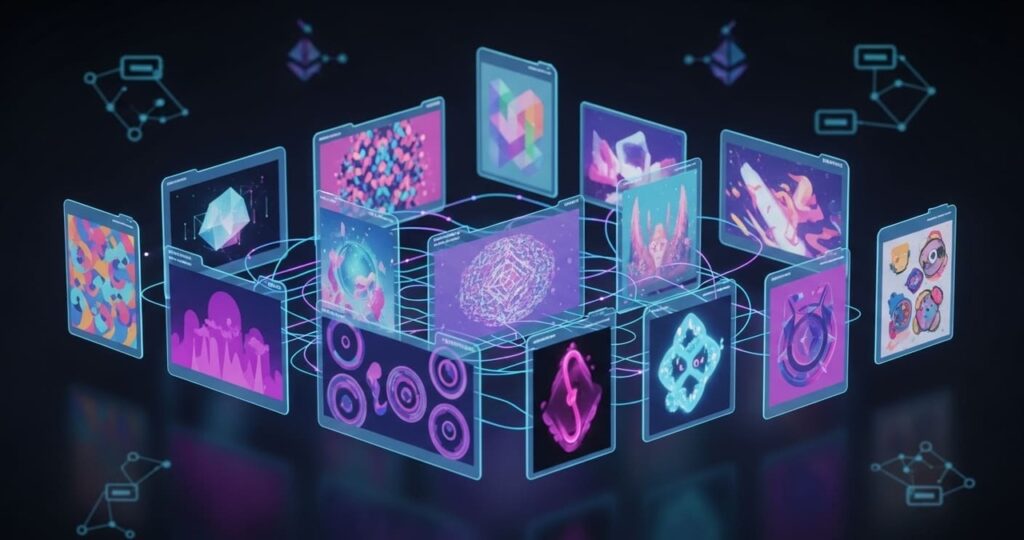
This community ethos was reflected in the very nature of the art on Hicetnunc. It celebrated the digitally native: generative art coded in Processing or p5.js, glitch art that manipulated data streams, intricate pixel art, and abstract 3D animations. There was a rawness and an experimental spirit that felt closer to browsing an avant-garde digital zine from the early web than a high-stakes auction house. Artists played with the platform’s constraints, creating interactive OBJKTs or series that unfolded over multiple mints. The low financial barrier meant artists could take risks, mint single-edition works alongside large editions of hundreds, and engage directly with their audience. This environment nurtured a golden age for a certain type of digital artist, one for whom the process and community were as important as the final sale. The Hicetnunc art scene became synonymous with a purist, artist-driven approach to web3, a testament to what was possible when the tools of ownership were placed directly in the hands of creators.
The Technology Behind the Movement: Tezos and FA2
To fully appreciate the disruption of Hicetnunc art, one must understand the technical bedrock that made it possible. The Tezos blockchain was not a random choice; it was a core tenet of the platform’s philosophy. Unlike the energy-intensive mining process of Ethereum at the time, Tezos uses a Liquid Proof-of-Stake (LPoS) model. In this system, token holders who “bake” (similar to staking) their Tezos (XTZ) secure the network and validate transactions, consuming energy comparable to running a standard web server. This dramatic reduction in carbon footprint allowed artists and collectors to participate without the ecological guilt that was becoming a major point of contention in the wider NFT conversation. The sustainability of Hicetnunc art was a powerful ethical and marketing tool, attracting a conscientious cohort to the space.
The second technological pillar was the FA2 token standard. FA2 is a versatile, multi-asset interface standard for Tezos that can represent both fungible (like currencies) and non-fungible tokens. Its flexibility allowed Hicetnunc to implement features like editioned works (where hundreds of copies of the same NFT could be minted) and interactive OBJKTs that could change state. The combination of Tezos and FA2 meant transactions were not only green but also fast and incredibly cheap. A collector could buy a piece of art on Hicetnunc, tip an artist, and swap a few Tezos-based tokens all within minutes for a total cost of under a dollar. This frictionless economic layer was the engine of the platform’s hyper-engaged community, enabling micro-patronage and spontaneous collecting that would have been economically impossible on other chains. It demonstrated that blockchain technology could be harnessed for cultural production at a human scale.
The Diverse Universe of Artistic Expression on H=N
The types of Hicetnunc art that flourished were as diverse as the global community that created them. The platform became a living catalog of early 2020s digital art trends. Generative art was arguably the crown jewel. Artists like Tyler Hobbs (who found early traction on H=N before his iconic Fidenza series), Iskra Velitchkova, and countless others used algorithms to create unique, code-based works that were minted as individual editions from a single script. Each piece was a collaboration between the artist’s rules and the blockchain’s entropy. Glitch art, which aestheticizes digital errors and data corruption, also found a natural home, with artists like Shvembldr and Shindo exploring the beauty of broken systems.
Beyond these, the platform teemed with pixel art, echoing the nostalgia of 8-bit and 16-bit gaming eras. Digital painting and illustration thrived, with artists such as Shilly and Shmemmy building devoted followings. Photographers began tokenizing their work, and poets experimented with text-based NFTs. A particularly fascinating subculture was that of “on-chain” or “fully stored on-chain” art on Hicetnunc, where the entire artwork’s code was written directly into the token’s metadata, ensuring its immortality and independence from any external server. This dedication to the medium’s possibilities made browsing H=N an endless journey of discovery, where the next click could reveal a hypnotic animation, a stark geometric composition, or a poignant piece of digital poetry. The lack of a rigid curatorial hierarchy meant that a legendary generative artist’s work could sit next to a first-ever mint from a teenager, democratizing visibility in a way no physical gallery ever could.
The Sudden Silence: The Shutdown of Hicetnunc
The trajectory of Hicetnunc art was meteoric, but its descent was abrupt and shocking. On November 14, 2021, with little warning, the platform’s founder, Rafael Lima, took the site offline. The frontend disappeared, replaced by a simple, cryptic message. The community was plunged into chaos and confusion. The decentralized nature of the technology meant the NFTs themselves—the tokens on the Tezos blockchain—were safe, owned by the collectors in their wallets. However, the primary interface, the gallery, the marketplace, and the cultural hub through which people interacted with their Hicetnunc art was gone. Rumors and theories proliferated: was it a protest against the increasing commercialization of space? Was it burnout from maintaining a massive, community-driven project largely single-handedly? Was it a response to technical or legal pressures?
While Lima’s full motivations remain partially private, the act itself became a powerful, if traumatic, part of the platform’s legend. It was a stark reminder of the centralized vulnerabilities that can underpin even the most decentralized-friendly projects. The shutdown forced the community to confront a critical web3 principle: “Not your keys, not your crypto.” In this case, it was “not your interface, not your gallery.” Overnight, collectors and artists lost their primary means of displaying, discovering, and trading the OBJKTs they loved. This event triggered a profound scramble and became a catalyst for the next phase of the Hicetnunc art legacy: resilience and decentralization. The community, though fractured, refused to let its shared cultural archive vanish into the digital ether.
The Phoenix Projects: Carrying the Hicetnunc Torch
From the ashes of the main platform’s shutdown, several crucial projects emerged, dedicated to preserving and continuing the spirit of Hicetnunc art. These initiatives underscored the community’s determination and the decentralized ethos it always championed. The most critical was the archival effort. Websites like Hicetnunc.xyz and H=N Archive (also known as henarchive) sprang up, providing alternative interfaces to view the OBJKTs minted on the original platform. These archives used the immutable Tezos blockchain data to reconstruct the gallery, ensuring that the vast body of work remained accessible and visible. They became essential resources for historians, collectors, and artists seeking to prove their provenance in the Hicetnunc art movement.
Simultaneously, new marketplaces built specifically for the Tezos ecosystem rose to fill the void. Platforms like Teia.art, Objkt.com, and Fx(hash)—the latter becoming a powerhouse for generative art—explicitly positioned themselves as spiritual and technical successors. Teia.art, in particular, was formed as a direct community-owned and governed fork of Hicetnunc’s open-source code, operated by a decentralized collective of former users. These platforms not only provided a new home for existing Hicetnunc art but also evolved the model, incorporating improved features, community governance votes, and continued support for artists. They proved that the underlying values of low-cost, accessible, community-focused NFT art were bigger than any single website. The ecosystem didn’t die; it fragmented, evolved, and grew stronger, with the memory of H=N serving as its foundational myth.
The Lasting Impact and Legacy on the NFT World
The influence of Hicetnunc art on the broader NFT and digital art landscape is deep and enduring. First and foremost, it permanently validated the “green NFT” narrative. By showcasing a thriving, high-quality art scene on an energy-efficient blockchain, H=N forced the entire industry to confront its environmental impact. This pressure contributed to Ethereum’s own eventual shift to a proof-of-stake consensus mechanism (The Merge). Hicetnunc proved that ecological responsibility and cutting-edge digital art were not just compatible, but could be synergistic.
Secondly, it democratized the NFT space in a profound way. By lowering the financial barrier to near-zero, it enabled a global, diverse wave of artists to enter web3 who otherwise might never have participated. This influx of fresh perspectives greatly expanded the artistic vocabulary of NFTs beyond the cartoon apes and pixelated punks that dominated mainstream media. The Hicetnunc art model of editioned, affordable works also popularized the concept of art as a broadly accessible collectible, not just a trophy asset for the wealthy. Furthermore, its community-driven, artist-centric ethos established a blueprint for how web3 platforms could and should operate, emphasizing collaboration over competition, and curation over pure speculation. The legacy of Hicetnunc art is etched into the DNA of the entire Tezos art ecosystem and serves as a constant reference point for what is possible when technology is aligned with humanistic and artistic values.
Collecting Hicetnunc Art Today: A Guide
For new collectors intrigued by the history and aesthetic of Hicetnunc art, the landscape today, while different, is very much alive. The primary venues are the successor platforms on Tezos. Objkt.com and Teia.art are the largest general marketplaces where the vast majority of original H=N OBJKTs are listed for sale. Fx(hash) is the premier destination for generative art, hosting both new works and historical generative pieces originally minted on Hicetnunc. To start collecting, you’ll need a Tezos-compatible wallet like Temple or Kukai. After purchasing a small amount of XTZ from an exchange and transferring it to your wallet, you can connect to these marketplaces and begin browsing.
When collecting historical art on Hicetnunc, provenance is key. Check the mint date on the token’s details page; anything minted before November 2021 is a genuine piece of H=N history. Look for the original platform attribution. Given the community’s archival efforts, purchasing an OBJKT on these modern platforms is safe—the NFT is the same token on the blockchain, just viewed through a different window. Collecting today connects you to a pivotal art historical moment. You’re not just buying a digital image; you’re becoming a custodian of a piece of the Hicetnunc art revolution, supporting artists who were at the heart of a paradigm shift, and participating in a community that remains passionate about the art first and foremost.
Hicetnunc vs. The Contemporary NFT Landscape
To contextualize the unique position of Hicetnunc art, it is helpful to compare its model with the broader NFT market, both then and now. The following table highlights key distinctions:
| Blockchain & Ecology | Tezos (Proof-of-Stake). Very low energy, “green” ethos. | Ethereum (Proof-of-Work). High energy consumption, environmental concerns. | Ethereum (now PoS), other chains like Solana, Polygon. Energy concerns reduced. |
| Cost to Mint/Buy | Extremely low (<$1 typically). Microtransactions feasible. | Very high, volatile “gas fees” (often $50-$500+). Barrier to entry. | Variable. Lower on L2s (Polygon) & other chains, higher on main Ethereum. |
| Primary Focus | Art and community. Experimental, digital-native works. | Speculation and status. High-value PFP projects, celebrity drops. | Diverse. Strong art sectors (Art Blocks) coexist with speculative & utility projects. |
| Community Vibe | Collaborative, artist-driven, curatorially focused. Like a digital art collective. | Investor-focused, financially driven. Often centered on project-specific roadmaps. | Spectrum from highly commercial to niche artistic communities. |
| Platform Control | Initially centralized frontend (a vulnerability), but decentralized assets. | Mix of centralized platforms (OpenSea) and decentralized assets. | Movement towards more decentralized governance and open-source frontends. |
| Lasting Legacy | Proved viability of low-cost, eco-conscious art NFTs. Built a legendary community. | Drove mainstream awareness and established the basic NFT market infrastructure. | The H=N ethos is embedded in many current artist-focused platforms and communities. |
This comparison shows that Hicetnunc art occupied a distinct, ideologically purist corner of the NFT universe. It wasn’t trying to compete with the Bored Ape Yacht Club; it was building something entirely different—a digital atelier for the 21st century.
Voices from the Community: Quotes on the Hicetnunc Phenomenon
The impact of Hicetnunc art is best understood through the words of those who lived it.
- An anonymous early adopter and collector said, “Hicetnunc wasn’t about flipping for profit. It was about the thrill of the hunt. You’d spend hours diving down rabbit holes, finding these incredible artists with 10 followers. Buying their work for a couple of Tezos felt like being part of a secret, global art movement. You weren’t just a collector; you were a patron and a participant.”
- A generative artist who gained recognition on the platform noted, “H=N was the first place that made NFTs feel intellectually and artistically legitimate for me. The low minting cost was like having a limitless digital canvas. I could mint 100 iterations of a sketch, see what resonated, and engage directly with people who genuinely cared about the algorithm and the aesthetics, not just the potential ROI. It was a pure studio environment.”
- A community archivist involved in preservation efforts reflected: “The shutdown was devastating, but in a way, it completed the lesson of decentralization. The art was always ours—on our wallets, on the chain. We just had to build new doors for it. Preserving Hicetnunc art became a labor of love for the community. It proved that the culture we built was more resilient than any single website.”
These testimonials capture the essence of the experience: community, artistic freedom, and a shared belief in a different kind of digital future.
Conclusion: The Eternal “Here and Now”
The story of Hicetnunc art is a foundational myth for the digital age. It demonstrates how a simple tool, built on thoughtful technology and animated by a powerful human desire for connection and expression, can ignite a global movement. Hicetnunc challenged the nascent NFT industry’s worst impulses—speculative frenzy, environmental negligence, and exclusionary economics—and offered a compelling, beautiful alternative. It showed that the soul of web3 could be artistic, communal, and accessible. While the original platform is gone, its spirit is immortal. It lives on in every low-mint-cost generative art piece on Fx(hash), in every community governance vote on Teia, and in the thousands of OBJKTs that continue to be treasured in digital wallets around the world. The art on Hicetnunc captured a specific “here and now” in 2021, but its lessons about empowerment, sustainability, and community are timeless. It remains a north star for artists and builders who believe that blockchain’s highest purpose is not to create new millionaires, but to foster new forms of culture, forever changing how we create, share, and own the digital expressions of our humanity.
Frequently Asked Questions About Hicetnunc Art
What exactly was Hicetnunc?
Hicetnunc was a pioneering NFT marketplace and social platform launched in March 2021, built on the energy-efficient Tezos blockchain. It was specifically designed to enable artists to mint and sell digital artwork as NFTs (called OBJKTs) at extremely low cost, often for less than one dollar. It quickly grew into a massive, vibrant community focused on experimental, digital-native Hicetnunc art, prioritizing artistic innovation and accessibility over high-value speculation.
Is Hicetnunc still active? Can I buy or sell the art anymore?
The original Hicetnunc website was taken offline by its founder in November 2021. However, the art on Hicetnunc itself—the NFTs minted on the platform—live permanently on the Tezos blockchain. You can actively buy, sell, and trade these historical OBJKTs on successor Tezos marketplaces like Objkt.com, Teia.art, and Fx(hash). These platforms provide the interface to interact with the legacy of the Hicetnunc art collection.
Why is Hicetnunc art considered so important for the NFT world?
Hicetnunc art is historically crucial for several reasons. It proved the viability and appeal of “green NFTs” on eco-friendly blockchains like Tezos, changing the environmental conversation. It democratized access by allowing anyone to mint art affordably, leading to an unprecedented global explosion of creativity. Finally, it established a powerful, enduring model of a community-centric, artist-first NFT ecosystem, influencing the ethos of countless platforms that followed.
How can I be sure I’m buying an original Hicetnunc piece?
When browsing on current marketplaces, check the token’s details. An original piece of Hicetnunc art will have a mint date prior to November 14, 2021. The platform information will often still list “hicetnunc.xyz” as its origin. The blockchain data is immutable, so the provenance of these OBJKTs is clear and verifiable, making them distinct from art minted on newer platforms.
What happened to the artists who were on Hicetnunc?
The vast community of artists from Hicetnunc migrated and continues to thrive. Many are now leading figures on the Tezos ecosystem platforms mentioned above, such as Teia and Fx(hash). Some have also gained recognition on other blockchains. The network and reputation they built during the Hicetnunc art era served as a powerful launchpad, and the community connections formed then remain strong, with artists frequently collaborating and supporting each other’s work on new platforms.