

Princess Mako’s story bridges ancient imperial traditions with the forces of modern individualism. The Japanese Imperial Household, long seen as a bastion of stoic ritual, now serves as the stage for her quiet revolution. As the eldest daughter of Prince Fumihito and niece of Emperor Naruhito, her shift from official duties to life as a commoner in a small New York apartment captured the world’s attention.
To understand the significance of Princess Mako, one must look beyond the tiara and the formal portraits. She represents a generation grappling with the tension between the weight of expectation and personal happiness. Her story is layered with academic achievement, a fairy-tale romance that turned into a public spectacle, and a decision that ultimately redefined her place in history. While many royal families across Europe have adapted to the changing times, the Japanese Chrysanthemum Throne remains deeply traditional, making Mako’s path one of the most talked-about royal departures in recent memory. This article delves deeply into her life, exploring her childhood, education, controversial engagement, and her new life as a commoner in the United States.
The Early Life of a Princess Mako
Born October 23, 1991, at the Imperial Household Agency Hospital in the Tokyo Imperial Palace, Princess Mako entered the world as Emperor Akihito and Empress Michiko’s first grandchild. Raised under imperial duty and a grounded family ethos, her parents aimed for a normal upbringing despite palace life. She attended public school for a time and joined in activities typical of Japanese children, contrasting the isolation experienced by other royals.
As a child, Princess Mako was described by those who knew the family as curious and gentle. She developed a love for animals and nature, often accompanying her parents on official outings. Her education began at the Gakushuin Primary School, an institution historically associated with the education of Japan’s nobility and imperial family. However, her path diverged slightly from the norm when she later attended the International Christian University (ICU) in Tokyo. This choice was significant; ICU is known for its liberal arts curriculum and international focus, suggesting that even in her youth, Princess Mako was cultivating a worldview that extended beyond the insular environment of the imperial household.
Her academic pursuits were not merely ceremonial. Princess Mako was a dedicated student with a passion for the arts. She focused her studies on art and cultural heritage, a field that allowed her to explore the aesthetic history of Japan and the world. This intellectual curiosity would later define her role as a working royal, as she frequently visited museums and cultural institutions to deepen her understanding of the arts. Unlike some royal figures who serve as figureheads, Princess Mako approached her duties with the eye of a scholar, often engaging in detailed discussions with curators and historians.
The early years of Princess Mako also established her as a media darling in Japan. The public watched her grow from a shy child into a poised young woman. She was often photographed during the New Year’s greetings at the palace, her warm smile and genuine demeanor endearing her to the nation. The Japanese press, usually restrained in its coverage of the imperial family, portrayed her positively as a symbol of youthful grace. However, this benevolent spotlight would eventually turn harsh, casting a shadow over the very personal choices she would later make.
Education and International Experience
One of the defining aspects of Princess Mako’s character is her global perspective, cultivated through extensive education both in Japan and abroad. While enrolled at ICU, she seized the opportunity to study overseas, a move that was encouraged by her forward-thinking parents. In 2010, she spent time at the University of Edinburgh in Scotland, immersing herself in British culture and the academic rigor of one of the UK’s top institutions. This experience was pivotal; it was likely the first time she lived independently, away from the constant gaze of the Imperial Household Agency and the Japanese media.
Her time in Edinburgh was followed by a period at the University of Leicester, where she pursued a Master of Arts in Museum Studies. This choice was a deliberate step toward a professional career. Princess Mako was not content to simply be a ceremonial figure; she wanted to contribute meaningfully to the field of art and heritage. Her studies in Leicester were rigorous, covering everything from collection management to the ethics of museum curation. It was a practical degree, one that equipped her with the skills necessary for a professional life, should she ever choose—or be forced—to pursue one.
Upon returning to Japan, Princess Mako attempted to integrate her academic knowledge into her royal duties. She worked as a special researcher at the University Museum of the University of Tokyo, a role that allowed her to apply her education in a practical setting. She also served as a visiting researcher at the Tokyo National Museum, further solidifying her reputation as a serious scholar. For a brief period, it seemed that Princess Mako had found the perfect balance: she could serve the imperial family while engaging in her passion for cultural preservation.
This period of her life is crucial for understanding the woman she would become. The academic environment fostered her independence. It taught her to think critically and to value evidence and research over blind tradition. When she later faced intense public scrutiny, those who knew her from university described her as resilient and thoughtful, traits honed in lecture halls and museum archives. Her international education also gave her a comparative lens; she had seen how other cultures, particularly in Europe, viewed their monarchies with a mix of respect and casual modernity, a stark contrast to the reverent and often rigid expectations placed upon her at home.
The Duties of a Working Royal
Before her life became dominated by the drama of her engagement, Princess Mako fulfilled the traditional roles expected of an imperial family member. She accompanied her parents and grandparents on numerous official visits, both domestically and internationally. These duties were not merely symbolic; they required extensive preparation, cultural knowledge, and the ability to engage with dignitaries and citizens alike. Princess Mako approached these responsibilities with the same diligence she applied to her studies.
One of her most significant official roles was serving as the honorary patron of various organizations. She attended ceremonies for the Japan Tennis Association and the Japan Association for the 2025 World Exposition, among others. Her presence was often requested to lend a sense of tradition and grace to these events. The public would line the streets to catch a glimpse of her, waving small Japanese flags. In these moments, Princess Mako was the embodiment of the modern imperial family: approachable yet dignified, youthful yet respectful of tradition.
Internationally, she represented Japan with poise. In 2016, she visited Brazil to commemorate Japanese immigration to the country, a trip that highlighted the deep cultural ties between the two nations. She visited Japanese communities, spoke with descendants of immigrants, and connected with people on a human level. These trips were exhausting, often involving multiple events per day, strict protocols, and the constant pressure of being the face of Japan abroad. Yet, Princess Mako never faltered, earning praise from diplomats and the Imperial Household Agency for her composure.
However, beneath the surface of these polished appearances, there were signs of the strain that royal life imposed. The imperial family lives under what is often described as a “golden prison.” Every movement is documented, every word is scrutinized. For Princess Mako, who had tasted the relative freedom of student life in Scotland and England, the constraints of the palace may have felt increasingly suffocating. The duties were endless, and the personal life of a princess was virtually non-existent. This tension between public service and private desire is the backdrop against which her romance with Kei Komuro would unfold.
The Love Story That Shook the Throne
The love story of Princess Mako and Kei Komuro reads like a modern fairy tale, albeit one with a complicated and often painful middle chapter. The couple met in 2012 while both were students at the International Christian University in Tokyo. Their meeting was reportedly at a study abroad information session, a setting that perfectly encapsulates their shared interests in international affairs and education. What began as a casual friendship gradually blossomed into romance, with Komuro proposing to Mako in December 2013 after they had graduated.
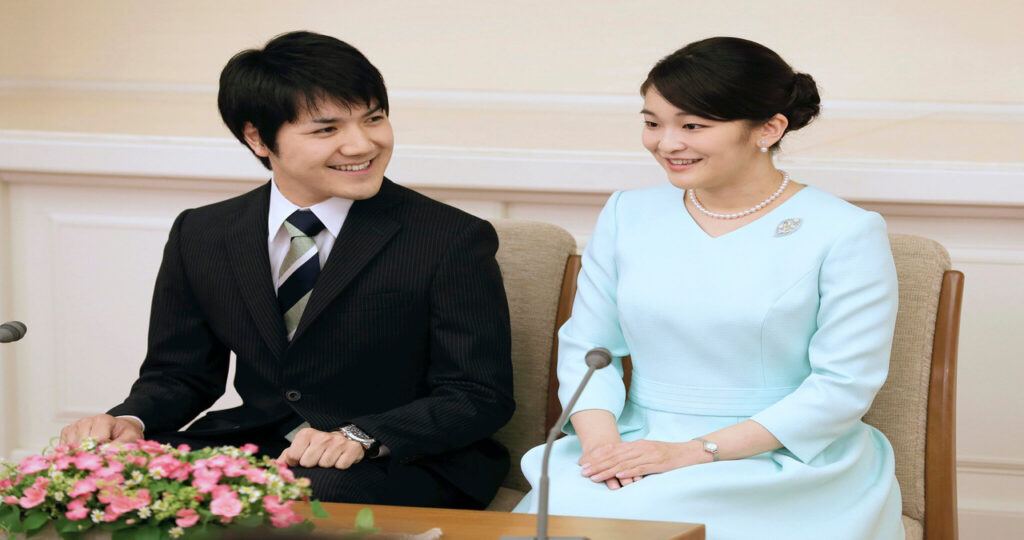
When their engagement was formally announced in September 2017, the nation initially reacted with joy. Kei Komuro was dubbed the “sea prince” by the media, a romantic nickname stemming from a beachside proposal. He was a handsome, well-educated commoner who worked at a law firm. It seemed like a perfect match: a princess following her heart, much like her aunt, Empress Masako, had done years before. The couple held a press conference where they appeared genuinely happy and in love. Princess Mako smiled as she described Komuro as “a smiling, sun-like person.”
However, the fairy tale quickly soured. The Japanese media, particularly the weekly tabloid magazines known as shukanshi, began digging into Komuro’s family history. Reports surfaced about a financial dispute involving his mother and her former fiancé, revolving around a loan of approximately four million yen (about $35,000). The former fiancé claimed the money was a loan that had not been repaid, while Komuro’s mother insisted it was a gift. This seemingly mundane financial squabble became a national scandal, and the narrative shifted dramatically. The “sea prince” was suddenly portrayed as a gold-digger from a problematic family.
The Imperial Household Agency, tasked with protecting the dignity of the imperial family, was put in an impossible position. The public, fueled by sensationalist media coverage, turned against the marriage. Polls showed that a majority of Japanese people did not support the union. Princess Mako found herself at the center of a media storm. The pressure became so intense that in February 2018, the couple announced that they would postpone their wedding ceremonies and the rituals associated with the engagement, citing a lack of time to prepare. In reality, the postponement was an attempt to quell the public outcry and allow Komuro to address the financial allegations.
The Long Engagement and Public Scrutiny
What followed the postponement was a nearly four-year period of limbo that tested the resilience of Princess Mako and Kei Komuro like never before. In 2018, Komuro left Japan to study law at Fordham University in New York, a move that was interpreted by some as an escape from the relentless media harassment. The separation was physically and emotionally draining for the couple. They were forced to maintain a long-distance relationship while Komuro attempted to build a career abroad and resolve the financial dispute that had tarnished his reputation.
During this time, the media scrutiny did not abate; it intensified. Every detail of Komuro’s life in New York was reported on. Paparazzi photographed him walking through the city, his hairstyle becoming a topic of national discussion in Japan. The financial dispute remained a constant shadow. Komuro released a 24-page statement through his lawyer in an attempt to explain his side of the story, but for many, the damage was already done. The tabloids painted a picture of a man who was unreliable, whose family was troublesome, and who was unworthy of a princess.
Princess Mako, meanwhile, remained in Japan, continuing her royal duties and her research work, all while enduring the whispers and the pitying glances. The psychological toll on her was reportedly severe. In a rare and unprecedented move, the Imperial Household Agency later confirmed that Princess Mako was suffering from complex post-traumatic stress disorder (PTSD), a diagnosis attributed to the prolonged and intense mental stress she had endured. She described feeling “fearful and sad” about the situation, a stark admission of vulnerability from a family that typically maintains a stoic silence.
This period highlighted a significant disconnect between the imperial family and a segment of the Japanese public. While many older, traditionalist Japanese citizens believed the princess should abandon the engagement for the sake of the family’s honor, a younger generation began to sympathize with her. Social media became a battleground, with supporters of the couple using hashtags to express their hope that the princess could marry for love. The prolonged ordeal transformed Princess Mako from a royal figure into a symbol of the struggle for individual autonomy against overwhelming societal pressure.
Marriage and the Loss of Royal Status
On October 26, 2021, Princess Mako finally married Kei Komuro, bringing an end to the years of uncertainty. The day was notably devoid of the traditional celebrations associated with a royal wedding. There was no elaborate engagement ceremony (Nosai), no lavish banquet, and crucially, no dowry. Princess Mako refused the one-time payment of up to 152.5 million yen (about $1.3 million) typically given to imperial women upon leaving the family to start a new life. This decision was a powerful statement; she wanted to sever all financial and formal ties with the institution that had caused her so much pain.
The ceremony itself was stark. The couple registered their marriage at a local government office before holding a simple press conference at a hotel in Tokyo. It was a somber affair, far removed from the joyous occasions usually associated with royal nuptials. At the press conference, Princess Mako, now legally a commoner, appeared visibly nervous but resolute. She reiterated her love for Komuro, stating, “For us, getting married was a necessary choice to live while cherishing our hearts.” The couple did not answer questions from the media, releasing a pre-written statement instead, a decision that underscored their deep distrust of the press.
Upon marriage, according to the Imperial Household Law of 1947, Princess Mako lost her imperial title and status. She ceased to be a member of the imperial family and became, in the eyes of the law, an ordinary Japanese citizen. Her passport was now a regular Japanese passport, and her name was officially changed to Mako Komuro. This transition is one of the most significant aspects of her story. While other royal families allow princesses to retain their titles upon marriage, the Japanese law is absolute: women cannot remain in the family if they marry a commoner.
This legal reality places Princess Mako in a unique position. She is a former princess navigating the world as a private citizen for the first time in her life. The loss of status is not just ceremonial; it is practical. She no longer has security details provided by the state, nor does she have the support network of the Imperial Household Agency. As she prepared to leave Japan with her husband, the world watched to see how this modern-day princess would adapt to a life of anonymity and independence.
Life in New York: A New Chapter
After their marriage, Mako Komuro and her husband relocated to New York City, where Kei had been living and working as a lawyer. For Mako, the move represented a complete upheaval. She went from the guarded, structured environment of the Akasaka Estate in Tokyo to the chaotic, vibrant, and often indifferent streets of Manhattan. The transition was a leap into the unknown, and for the first few months, the media frenzy followed them. Paparazzi camped outside their apartment, and every grocery run was documented by the Japanese tabloids, who seemed determined to continue their coverage.
Life in New York has required significant adjustment. Mako, who once had attendants to manage her schedule, now has to handle the mundane tasks of daily life: cooking, cleaning, and commuting. She has been spotted doing her own grocery shopping at Fairway Market, wearing casual clothes and blending in, as much as someone followed by photographers can blend in. For a woman raised in the imperial palace, these simple acts of independence are both liberating and challenging. She is learning to navigate a world without protocol, where she must make her own decisions and manage her own affairs.
Professionally, Mako has taken steps to build a career. She volunteered at the Metropolitan Museum of Art, leveraging her master’s degree in museum studies. This role was a perfect fit, allowing her to engage with art and culture in a practical, behind-the-scenes capacity. Later, she took on a position as a curatorial assistant at the museum, a job that requires dedication and expertise but offers the anonymity she craves. Unlike in Japan, where her presence would cause a stir, at the Met, she is just another staff member working to preserve and interpret art.
The couple has worked hard to establish a normal life. They have been seen attending classical music concerts, visiting art galleries, and simply walking their dog in the city. While the intense media scrutiny has eased somewhat, they remain a subject of fascination. For Mako, New York represents a sanctuary. It is a place where she is not defined by her lineage but by her actions. The city’s diversity and fast pace have allowed her to disappear into the crowd in a way that was impossible in Japan. It is here that she is slowly, but surely, building the life she fought so hard to have.
The Future of the Japanese Imperial Family
The departure of Princess Mako has cast a renewed spotlight on the precarious future of the Japanese imperial family. Her marriage and subsequent exit from the family exacerbated a long-standing succession crisis. Currently, the imperial family has very few male heirs. After Emperor Naruhito, the next in line is his brother, Prince Fumihito (Mako’s father), followed by his nephew, Prince Hisahito (Mako’s younger brother). If Prince Hisahito were to have no male children, the centuries-old lineage would be at risk of extinction.
This situation has reignited a contentious debate in Japan: should women be allowed to retain their imperial status after marriage, and should they be allowed to ascend the Chrysanthemum Throne? Princess Mako’s case is a prime example of the law’s rigidity. Had she married a commoner but been allowed to stay in the family, the pool of imperial members would be larger. Furthermore, allowing female monarchs (either as empresses regnant or as heads of family branches) would provide stability to the succession. However, this idea is met with fierce resistance from traditionalists who argue that the male lineage must remain pure.
Princess Mako’s younger sister, Princess Kako, now finds herself in a similar position. As a woman, if she marries, she too will be forced to leave the imperial family. This prospect is deeply troubling for those who wish to preserve the family’s numbers. The public, having watched the treatment of Mako, is now more sympathetic to the plight of the female members. There is growing support for changing the law, though political will remains weak due to the conservative nature of the ruling party.
The story of Princess Mako is therefore not just an isolated romantic drama; it is a catalyst for a national conversation about tradition, gender equality, and the very definition of the monarchy in the 21st century. Her struggle has humanized the crisis, showing the public that behind the debate over succession laws are real women facing impossible choices between family duty and personal happiness. Whether her departure will ultimately lead to reform remains to be seen, but it has undoubtedly planted a seed of change in the public consciousness.
Comparison: Princess Mako vs. Other Royal Figures
To fully appreciate the unique path of Princess Mako, it is helpful to compare her journey with that of other royal figures who have navigated the intersection of love, duty, and public life. While every royal family operates under different rules, the common thread is the intense scrutiny that accompanies any deviation from tradition. The table below highlights key differences and similarities between Mako and other notable royals.
| Reason for Exit | Marriage to a commoner (required by law) | Stepping back from royal duties due to media pressure and lack of support | Marriage to a commoner (required by law) |
| Title Upon Marriage | Lost title; became Mako Komuro (commoner) | Retained title (Duchess of Sussex) but stopped using HRH | Lost title; became Sayako Kuroda (commoner) |
| Media Treatment | Intensely negative; tabloids scrutinized husband’s family finances | Mixed; intense scrutiny from UK tabloids, often with racial undertones | Generally respectful; husband was a family friend, little scandal |
| Geographic Outcome | Moved to New York City, USA | Moved to Montecito, California, USA | Remained in Japan; works as a researcher at Ise Shrine |
| Public Sympathy | Polarizing; younger generation sympathetic, older generation critical | Polarizing; strong support abroad, mixed views in the UK | High; marriage was seen as a natural, quiet transition |
| Financial Aspect | Refused the traditional lump-sum payment upon leaving the family | Became financially independent through commercial deals | Accepted the traditional lump-sum payment |
This comparison reveals that while Princess Mako’s situation has parallels with other royal women, particularly her own aunt, Princess Sayako, the intensity of the media hostility and her personal decision to refuse the dowry set her apart. Unlike Meghan, who chose to leave an institution she was already part of, Mako was legally obligated to leave the moment she married. Her refusal of the payment was a symbolic act of defiance that resonated globally, marking her as a royal who valued emotional integrity over financial security.
Public Perception and Media Legacy
The public perception of Princess Mako has undergone a significant evolution. In the early 2010s, she was widely admired as a graceful and intelligent member of the younger generation of royals. The media coverage was largely positive, focusing on her fashion, her studies, and her charming demeanor. However, the engagement to Kei Komuro acted as a pivot point, dividing the nation and transforming her image in the eyes of many. The tabloid media, in particular, played a destructive role, framing her love story as a national scandal rather than a personal matter.
In the years following the postponement of the wedding, a distinct generational divide became apparent. Older Japanese citizens, who hold the imperial family in near-sacred reverence, tended to view Mako’s insistence on the marriage as selfish and disrespectful to tradition. They were influenced by the tabloid narratives that portrayed Komuro as an unsuitable partner. On the other hand, younger people, particularly women, rallied behind Princess Mako. They saw her as a victim of a patriarchal system and a bullying media. Social media platforms became spaces where supporters could voice their hope for her happiness, countering the negative headlines.
The legacy of Princess Mako in the media is a cautionary tale about the power of the press. The relentless coverage of her personal life raised ethical questions about privacy and harassment. International media outlets often covered the story with bewilderment, unable to understand why a simple financial dispute warranted years of national obsession. This contrast between domestic and international coverage further highlighted the unique pressures of the Japanese imperial system.
Since her move to New York, the media frenzy has subsided, but the story is far from over. Princess Mako has become a symbol of resilience. She represents the possibility of life after the palace, a narrative that is both hopeful and melancholy. Her legacy will likely be that of a quiet revolutionary—a woman who did not shout or protest in the streets but who quietly, stubbornly, held onto her right to choose her own path, regardless of the cost.
Conclusion
The life of Princess Mako is a profound narrative of conflict between the individual and the institution. From her birth in the Tokyo Imperial Palace to her current life as a museum curator in New York, her journey has been marked by a constant negotiation between duty and desire. She began her life as a cherished princess, expected to embody the traditions of a millennia-old institution. Yet, she evolved into a symbol of modernity, choosing personal happiness over public expectation. Her story is not simply a royal romance; it is a human story about love, resilience, and the price of freedom.
Her decision to marry Kei Komuro, despite immense public opposition and personal cost, demonstrated a courage that transcended her royal upbringing. By refusing the traditional dowry and accepting the loss of her status without complaint, she maintained her dignity in the face of relentless scrutiny. She showed the world, and particularly Japan, that a woman’s worth is not defined by the titles she holds or the approval she receives, but by the integrity of her choices.
As Mako Komuro settles into her new life, the debate her story ignited continues. Will the Japanese imperial family reform its laws to prevent the loss of its female members? Will the media reconsider its treatment of public figures? These questions remain unanswered. However, what is certain is that Princess Mako has carved a unique place in history. She is no longer just a royal footnote; she is a protagonist in her own right, a woman who stepped out of the golden cage and into the uncertain, yet liberating, world of ordinary life.
Frequently Asked Questions about Princess Mako
Why did Princess Mako lose her royal status?
Princess Mako lost her royal status because she married a commoner, Kei Komuro. Under Japan’s Imperial Household Law of 1947, female members of the imperial family must relinquish their title and status upon marriage to a “commoner.” Male members who marry commoners, however, remain in the family. This law is a key point of contention in discussions about the future of the monarchy.
What does Princess Mako do for a living now?
After moving to New York City, Mako Komuro has pursued a career aligned with her academic background. She holds a Master’s degree in Museum Studies and has worked as a volunteer and later as a curatorial assistant at the Metropolitan Museum of Art. This role allows her to work behind the scenes in the art world, a passion she developed long before her marriage.
Why was there so much controversy surrounding her marriage?
The controversy stemmed primarily from a financial dispute involving her husband’s mother. Japanese tabloids reported that Kei Komuro’s mother had an unresolved debt with a former fiancé. The intense media coverage painted Komuro and his family in a negative light, leading to widespread public disapproval of the marriage. The prolonged scrutiny was cited as a cause for Princess Mako’s diagnosis of complex PTSD.
Did Princess Mako receive a dowry?
No, Princess Mako refused to accept the traditional lump-sum payment, known as chokin, which is typically given to female imperial family members upon their departure. This payment can amount to over a million dollars and is intended to help them maintain a standard of living after leaving the family. Her refusal was seen as a strong symbolic gesture, signaling her desire to sever formal ties with the institution and start her new life without financial obligation to it.
Where do Princess Mako and Kei Komuro live now?
Princess Mako and her husband, Kei Komuro, currently reside in New York City. Komuro works as a lawyer at a prestigious law firm, while Mako is involved with the Metropolitan Museum of Art. They live in a modest apartment in the Hell’s Kitchen neighborhood of Manhattan and have been spotted enjoying a relatively normal life, including walking their dog and shopping at local markets.
Is there any chance Princess Mako could return to royal life?
No, under the current Imperial Household Law, her departure from the imperial family is permanent. Once a female member marries a commoner, she and her descendants are forever excluded from the imperial lineage. There is no legal mechanism for her to regain her title or status, even if the laws were to change in the future, as those changes are unlikely to be applied retroactively.